
The promise of picking the right stock
There is a seductive version of investing that most people absorb from the culture: find the right company before everyone else does, buy in early, and watch it grow. The story of the person who bought Apple or Amazon early is retold constantly. What gets told less often is how many other bets — made with the same conviction, using the same research — quietly went to zero.
The practical problem with picking stocks is not a lack of effort. It is that markets process information very fast. By the time you have read an article about an undervalued company, thousands of professional analysts have already read it, and the price has largely adjusted. The advantage individual investors imagine they have — intuition, a different angle, a strong feeling — does not reliably translate into returns that beat the market over time.
What an index fund actually is
An index fund is a fund that holds every company in a particular market index, in proportion to that index's composition, and just sits there. An S&P 500 index fund holds shares in roughly 500 large U.S. companies — not because a manager decided those were the best picks, but because those are the companies that make up the index.
When one of those companies shrinks enough to fall out of the index, the fund sells its stake. When a new one enters, the fund buys in. The manager does not decide which companies to favor. The index decides, and the fund follows. The result: owning an index fund is essentially owning a slice of the entire market. You are not betting on who wins within the market. You are betting that the market as a whole will be worth more in ten or twenty years than it is today.
Why passive usually beats active over time
If talented professionals spend every working hour analyzing companies and markets, why don't they consistently outperform a fund that just buys everything?
The short answer is compounding friction. Every transaction an active fund makes costs something. Every analyst on the payroll costs something. Every research subscription, every trade, every rebalance eats into returns before they reach the investor. Active funds charge meaningfully more in annual fees to cover that overhead — often ten to twenty times more than a comparable index fund. A manager who picks stocks well enough to earn a return of 8% per year before costs might net the investor 6.5% after fees. An index fund earning the same 8% before fees might net 7.9%. According to widely followed SPIVA scorecards, roughly 9 out of 10 actively managed funds failed to match the S&P 500 over 15 years. That gap compounds, and over a decade or two a difference of 1–2 percentage points annually becomes a material difference in final portfolio value.
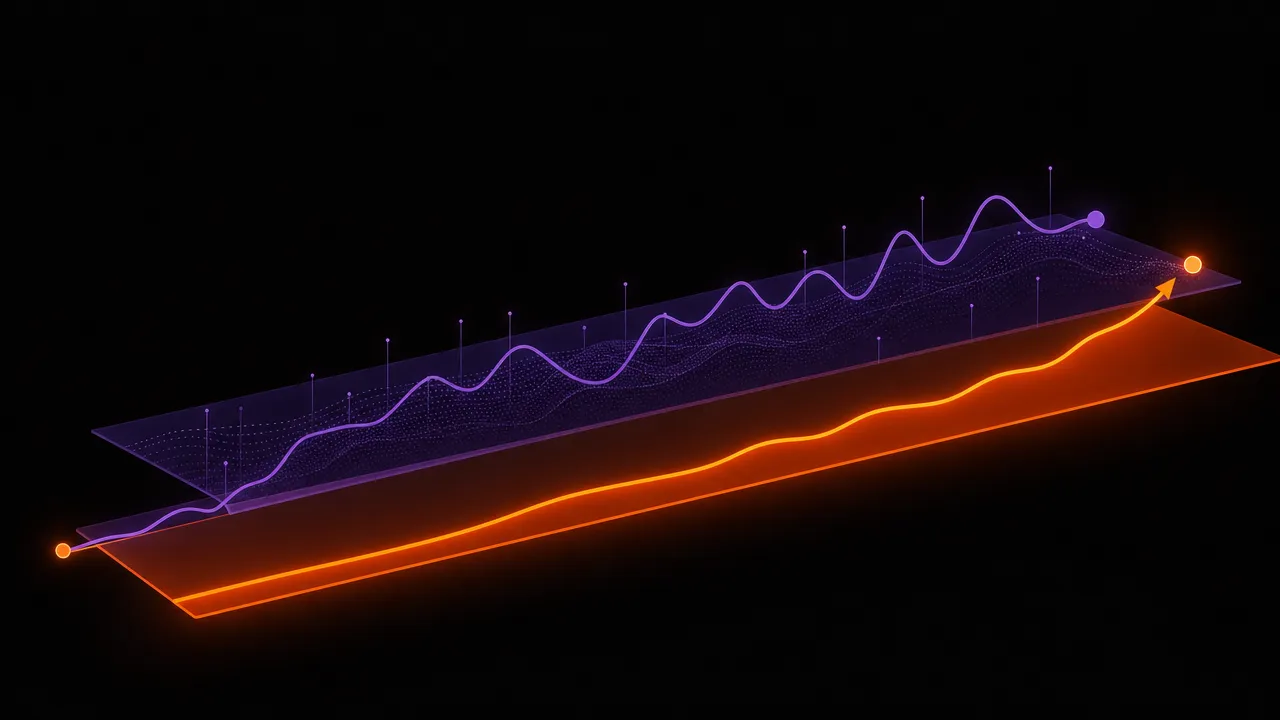
The fee gap is bigger than it looks
Expense ratios — the annual fee charged as a percentage of assets — are easy to ignore because they never show up as a bill. They are just quietly deducted from your returns.
- Typical actively managed funds charge around 0.5% to 1% per year. Index funds often charge 0.03% to 0.10%. The difference looks small. Over thirty years of compound growth, the accumulated impact is not.
- An investor in a high-fee active fund loses not just the fee itself, but the compounding that the fee would have produced if it had stayed invested.
- Costs are the only part of investing you can fully control. That is not ideology — it is math.
Index fund or index ETF: which to choose
Index funds come in two main forms that track the same underlying markets: traditional index mutual funds and index ETFs (exchange-traded funds). The difference is mostly mechanical.
Mutual fund shares are bought at the day's closing price and often have a minimum investment amount. ETFs trade throughout the day like individual stocks and can sometimes be purchased as a single share, making them more accessible if you're starting with a smaller amount. For most long-term investors, the difference matters less than picking one and starting. Both track indexes, both keep costs low, and both deliver the same core result: broad exposure at a fraction of the cost of active management.
A practical first step
- Open a brokerage account or use the retirement account you already have (401k, Roth IRA, or a direct brokerage).
- Look for an index fund tracking a broad market index — a total stock market fund or an S&P 500 fund is a common starting point.
- Compare expense ratios between funds tracking the same index and prefer the lower one, all else being equal.
- Set up automatic contributions on a regular schedule rather than waiting to invest manually each time.
- Leave it alone. The instinct to adjust constantly is one of the biggest drags on long-term index fund performance.

The one thing that trips up new index fund investors
Index funds do not protect you from market downturns. When the market falls 20%, a broad index fund falls roughly 20% too. The fund is not trying to dodge the drop — it holds everything, including the companies leading the decline.
The trap is selling during a downturn to stop the losses, then either staying in cash too long or waiting to get back in at a 'safer' moment. Both moves eliminate the benefit of having started. The design of an index fund is a long-term one: it requires a long enough time horizon that temporary drops are noise, not signals to act on. If a significant fall would cause you to sell, the right response is usually to review your overall asset allocation — how much is in stocks versus bonds or cash — rather than switching to a different stock strategy.
How Moneux fits into the picture
Knowing you want to invest in an index fund is one thing. Actually building the habit — automating the contribution, tracking how investments fit into your larger financial picture, keeping them visible next to your savings goals and spending — is what turns a one-time decision into a lasting behavior.
Moneux's net worth screen lets you track investment accounts alongside savings and debt, so the index fund you open this week doesn't become something you forget to check for three years.
Watch your investments grow alongside your savings
Moneux's net worth screen tracks investment accounts, savings goals, and debt in one view — so you can see how your index fund fits into your bigger financial picture.